¶ Introduction
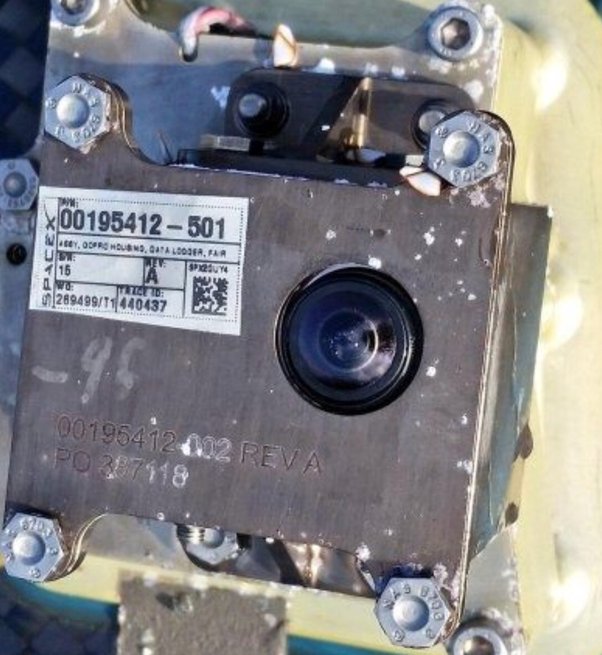
The goal of this project is to implement a working camera module on the rocket in order to get videos/pictures during the flight of Firehorn.
The main challenge will be to find and make a camera that can withstand the harsh outside conditions during the flight and transmit them to Ground Station.
¶ Requirements Needed
- 2024_C_SE_PL_CAMERAS_REQ_01 Declaration of purpose
Cameras shall be integrated into the launch vehicle to record the flight. - 2024_C_SE_PL_CAMERAS_REQ_02 Camera locations 1
A camera shall be located at the bottom end of the aerocover to record downwards during flight. - 2024_C_SE_PL_CAMERAS_REQ_03 Camera location 2
A camera should be located at the top end of the aerocover to record upwards during flight. - 2024_C_SE_PL_CAMERAS_REQ_04 Camera location 3
A camera should be located at the top of the avionics bay to record the parachute deployment. - 2024_C_SE_PL_CAMERAS_REQ_05 Maximum mass
A single camera and all its components shall have a maximum mass of 250g. - 2024_C_SE_PL_CAMERAS_REQ_06 Filming module dimensions
The filming module of the camera shall have a maximum cross-sectional area of [25]mm x [25]mm. - 2024_C_SE_PL_CAMERAS_REQ_07 Avionics independency - control
The camera module should not rely on the avionics module to start and/or stop the recording. - 2024_C_SE_PL_CAMERAS_REQ_08 Avionics independecy - power
The camera module shall not rely on the avionics module to be powered. - 2024_C_SE_PL_CAMERAS_REQ_09 Data storage
All data gathered by the camera shall be stored in a 'black box' designed by AV. - 2024_C_SE_PL_CAMERAS_REQ_10 Filming duration
The camera shall record the entire flight duration, from ignition to touchdown. - 2024_C_SE_PL_CAMERAS_REQ_11 Film quality
The camera shall record in at least 720P@60fps. - 2024_C_SE_PL_CAMERAS_REQ_12 Temperature resistance
The filming module of the camera located in the top end of the aerocover shall resist to temperatures of up to [TBD]K or have a thermal protection cover resisting those temperatures that still allows recording to happen. - 2024_C_SE_PL_CAMERAS_REQ_13 Interfaces with FD
The filming module of the camera shall fit in the aerocover tip geometry determined by FD. - 2024_C_SE_PL_CAMERAS_REQ_14 Interfaces with FD 2
The maximum temperature encountered by the camera located in the aerocover top end shall be determined by FD.
¶ Design objectives
The implementation of a camera module is a task that will require different points to be satisfied and that will be tested before the flight of Firehorn.
¶ Temperature resistance
Temperature has been identified to be one of the key issues of the succes of the camera module.
- In order for the camera to survive the flight, the temperature outside the rocket, at the interface with the rocket and inside the rocket must be known as the camera module will have to endure a combination of these temperatures for at least 3 minutes.
- Certain cameras generate more heat than others, and the heat generated by the camera will have to be known in order to answer the question of whether we need a heat exchanger or not.
¶ Space and avionics allocation
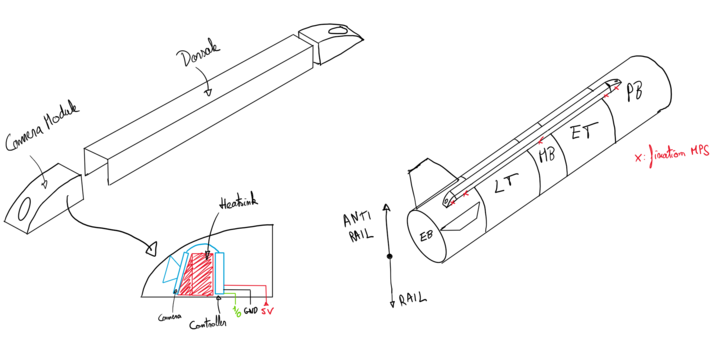
The camera module will be placed inside the "Dorsale" of the rocket, which limits its maximum space use. In addition to the space problem, the avionics of the camera module will be completely independent of Firehorn's avionics.
- The camera module must take as little space as possible with a consideration for mass (mass must be as low as possible).
- The avionics of the camera must be built with considerations to the harsh outside counditions during the flight and it must ensure the safe transmission of the videos and photos during or after the flight.
¶ Continuation of the project
The first steps of the design and manufacturing of the camera module will start following the end of the design of the Dorsale. After which this DJF will be modified to take into account future goals and advances and more attention will be paid to each requirement.