¶ 2025_C_ST_COPV_FEA
This document aims to present the method used to analyse with finite elements software the impact of the COPV on the ABRs of the Firehorn rocket.
¶ Geometry and Function
The COPV is a pressure tank situated at the top of the Pressurant bay, it is fixed on the lower ABR of the pressurant bay. It is a key piece of the rocket as it holds the most pressure of the tanks and is therefore used to route the different liquids to the engine. For this simulation we will use the pressurant bay composed of the 4 carbon fiber rods, and 2 ABRs.
¶ Material
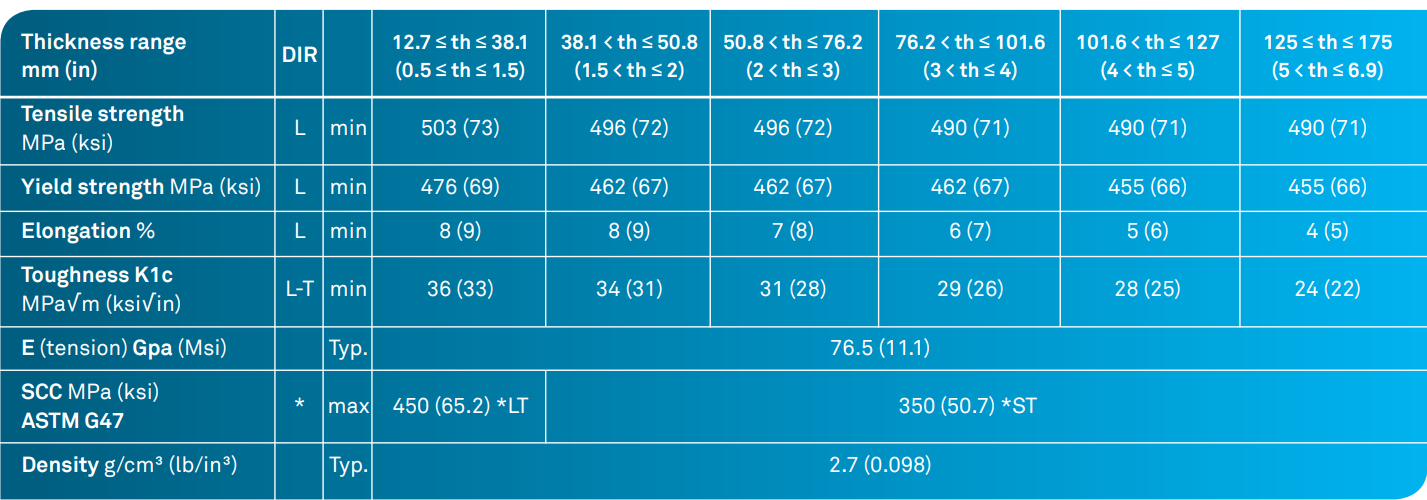
The ABRs are machined in 2050-T84 alloy. This alloy has the following properties:
The rods are made of CFRP whose layup is described in 2024_C_ST_CFRP-PLATE_MAP.
¶ Load case
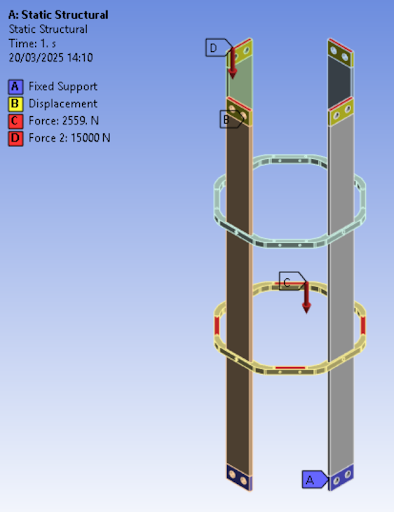
The force applied on the lower ABR is calculated as follows: 30 * g * m * FoS / = 30 * 9.81 * 8 * 2 = 4709N. This force is then equally distributed on the 4 faces of the ABR that are in contact with the COPV and its direction is the -y axis.
The force applied on the rods is 15,000 N which is the thrust of the engine with a FoS of 2, this force is also equally distributed on the 4 rods and its direction is the -y axis.
¶ Finite Element Analysis
¶ Software
The software used for the FEA analysis was Ansys, and the CAD of the assembly was made using Solidworks
¶ Type of simulation
The simulation performed was an eigenvalue buckling analysis to estimate the load multipliers and the Von mises constraints for the load case of 4709 N on the ABRS and 15,000 N on the rods
¶ Goal of the Simulation
The goal of the simulation is to validate that the COPV doesn't have an impact on the load multiplier of the pressurant bay, as well as verifying that the ABR holds the COPV with a MoS of 0.25, knowing that the material yield strength is 476 MPa.
¶ Inputs
We use the following unit system: mm-t-N-s-mV-mA
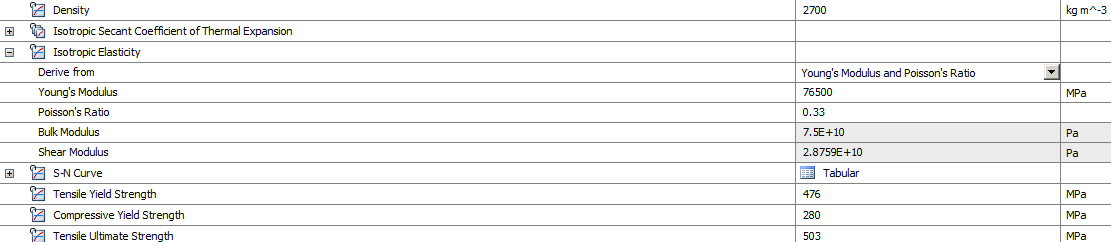
The material properties used were:
The boundary counditions were:
- The top parts of the rods are constrained to only a displacement in the y direction simulating the ears of the couplers. The bottom of parts of the rods are fixed.
Time was not taken into account for these simulations.
¶ Mesh
¶ Different mesh used
The three meshes used were 3mm and 4mm
¶ Mesh refinement
No refinement has been applied.
¶ Outputs
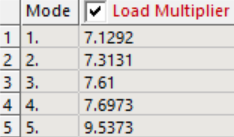
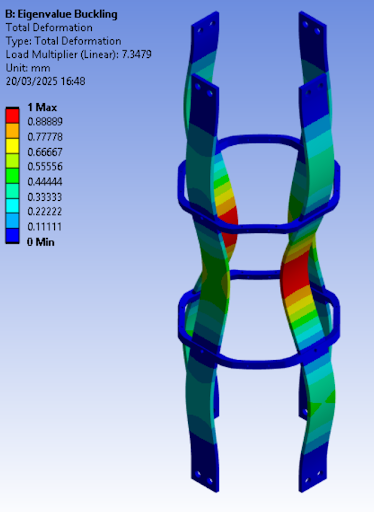
The load multiplers when accounting for the impact of the COPV on the pressurant bay is negligible as there is only a 5% difference between the load multipliers (7.5 vs 7.12). The new load multiplier is also largely above the minimum load multiplier of 3 necessary to validate the buckling of the pressurant bay.
Here is an example for the first mode of buckling:
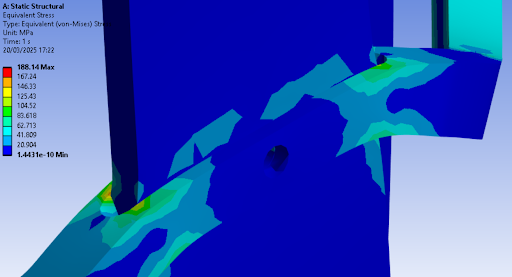
Finally, concerning the ABR we see that the force of the COPV on the ABR isn't critical as the maximum stress is 188 MPa which gives a Mos of (476/188)-1 = 1.57
Here is a zoom on the maximum stress on the ABRs (the deformation of the ABR isn't at scale)
¶ Interpretation
The COPV doesn't have a noteworthy impact on either the deformation of the ABRs or the buckling of the pressurant bay.
¶ Conclusion
The goal of reaching a 0.25 MoS is therefore attained, as for the load multiplier of 3.